ADHD Compensation Strategies for Adults: How I Designed a Clinical Note Template for My Brain

When people talk about ADHD compensation strategies for adults, the conversation often centers on familiar tools such as planners, alarms, calendar reminders, sticky notes, timers, or keeping important objects in the same place. Those strategies can be useful, but adult ADHD compensation can also be much more individualized. For me, some of the most effective ADHD coping strategies have come from paying attention to where my brain consistently encounters friction and then redesigning the task or environment around those patterns.
For me, compensation has increasingly meant paying attention to the places where my brain predictably encounters friction and then redesigning the task itself.
One of the clearest examples of this in my professional life is my clinical note template for ongoing therapy sessions with clients.
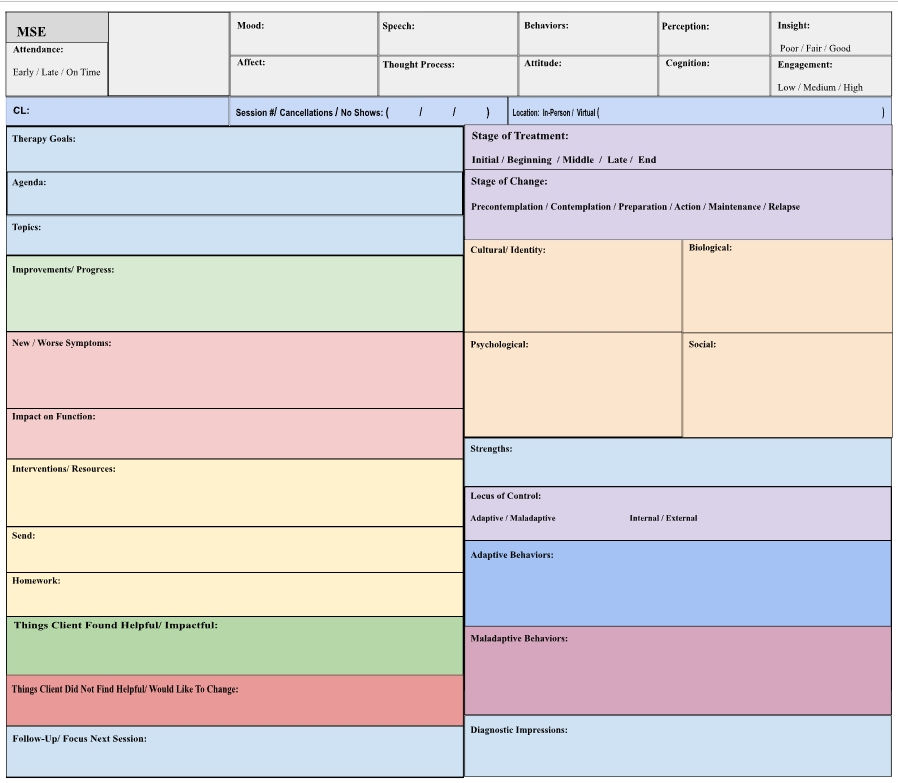
At first glance, the template I use during therapy sessions may look overly complicated. It is divided into numerous sections, organized across different parts of the page, and filled with colors that each have their own meaning. Someone else might look at it and wonder why I need so many boxes or why information is arranged in such a eccentric way.
That reaction would make sense because the document was never designed to be universally intuitive. It was designed to be intuitive to me.
Over time, I have essentially turned the template into a visual representation of the compensation strategies I use to manage my ADHD at work. It helps me organize information, reduce demands on working memory, limit my tendency to overwrite, transition more easily from one part of documentation to another, and maintain a stronger conceptual understanding of the client while still being present in the actual conversation.
The interesting part is that I did not sit down one day and intentionally say, "I am going to create an ADHD-friendly clinical documentation system." The template gradually evolved through years of noticing what did and did not work for me. Each revision solved a small problem. Eventually, those small solutions accumulated into a system that reflects how my brain processes information.
ADHD Compensation Strategies for Adults Are More Than Working Harder
I think one of the misconceptions surrounding ADHD is that difficulties with organization, memory, initiation, attention, or follow-through can always be overcome by simply trying harder. The problem with that idea is that many people with ADHD are already trying exceptionally hard.
The issue is often not a lack of effort. It is that a task is requiring cognitive processes that are difficult to consistently access under the conditions in which the task is being performed.
Clinical documentation is a good example of this.
During a therapy session, I am simultaneously listening to what someone is saying, considering what they may not be saying, tracking patterns across previous sessions, monitoring emotional and behavioral changes, choosing interventions, considering risk and diagnostic information, remembering treatment goals, managing time (well, sort of...), and thinking about where the session needs to go next.
Then, afterward, I need to translate that entire experience into concise clinical documentation.
That is a substantial amount of information to hold, organize, prioritize, and retrieve.
For my brain with ADHD, the most effective solution has not been telling myself that I should simply remember more of it. Instead, I have learned to externalize some of those cognitive demands.
Rather than relying entirely on my working memory to determine what matters, where it belongs, and what I need to remember later, I created a visual structure that helps carry some of that load for me.
That distinction has become increasingly important in how I understand compensation strategies. An effective compensation strategy does not necessarily make the underlying difficulty disappear. An adaptive strategy changes the environment so that the difficulty has less opportunity to interfere with functioning.
My Template Started With Knowing Where I Get Stuck
There are several characteristics of my own ADHD that influenced how this document developed.
I am visually drawn to color. A visually differentiated page holds my attention better than a large block of undifferentiated text on a white background (BORING!)
I also know that I can become stuck when there is too little structure. A blank page offers theoretically unlimited possibilities, but unlimited possibilities also mean unlimited decisions. Where should I start? What belongs here? How detailed should this be? Which part should I document first?
That type of decision-making can create unnecessary friction before I have even started the note.
I also have a tendency to overwrite. When I am trying to make sure I do not miss anything important, my instinct can be to capture too much information rather than too little. Everything can initially feel relevant because I can see the connections between different pieces of information.
There is also the memory component. I know that ADHD can affect working memory and information retrieval, and I have a strong desire to make sure important information is not lost. Sometimes there is also a fear underneath that: What if I do not remember this later?
That fear can create its own pressure to document everything.
The template gradually became my own answer to those patterns. Instead of repeatedly fighting the same tendencies, I started designing around them.
Color Is Not Decoration. It Is Information.
One of the most obvious features of my template is the use of color.
The colors are not there simply because I prefer colorful documents. They function as a visual language. Over time, I have repeatedly paired certain types of clinical information with specific colors, which allows me to locate information quickly without having to consciously read every heading.
The red areas represent information that generally signals concern: new or worsening symptoms, functional impairment, maladaptive behaviors, or aspects of the session that indicate something is not going well.
The green areas represent positive movement: improvements, progress, adaptive behaviors, and things the client reports finding helpful or impactful.
The blue sections tend to represent information connected to preparation, organization, or things I need before or after the active portion of the session. These sections help orient me to what I need to know going in and what may need attention afterward.
The yellow areas are especially action-oriented. They contain the things I am doing in session, resources client has consented to receive, homework or between-session tasks that client has agreed to, and other information that will eventually inform the plan portion of my documentation.
Gray is associated with behavioral and objective observations, particularly the information I am monitoring throughout the session rather than information directly reported by the client.
The orange and purple areas contain information that tends to be more conceptual or categorical. These are areas such as biopsychosocial considerations, stage of treatment, stage of change, locus of control, and related information that may evolve more gradually across treatment.
Because those associations have become familiar through repeated use, I can glance at the page and immediately orient myself.
If I need to check what the client said had improved, my eyes know where to go.
If something concerning emerges, there is already a visual home for me to jot that down.
If I think of a resource I need to send after the session, I do not have to trust myself to remember it an hour later. There is a designated place for it.
This is one reason I think ADHD compensation strategies can be more effective when they involve multiple forms of cueing. The heading tells me what belongs in a section, the location tells me where to look, and the color reinforces what kind of information I am dealing with. I am not asking one cognitive system to do everything.
The Page Follows the Way My Sessions Actually Unfold
The organization of the template matters just as much as the colors.
I have learned that I work better when the structure of my documentation mirrors the natural sequence of the task itself. If I have to constantly translate a conversation into a completely different organizational system while the conversation is still happening, I am creating another layer of cognitive work.
So the left side of my template is largely organized around the way my sessions tend to progress.
I usually begin with the broad themes or topics that are emerging that day. From there, we often discuss what has been going well. That naturally moves into what has been more difficult, including new symptoms, worsening concerns, stressors, or changes in functioning.
Those concerns frequently lead directly into interventions. What are we doing with this information? What skills are we practicing? What psychoeducation am I providing? What are we exploring differently?
From there, there may be resources I need to send or specific things the client wants to work on between session related to those interventions and skills.
As the session begins to close, I also want to know what the client found useful, whether there was anything that did not resonate, and what they want us to revisit during the next appointment.
The page flows downward in roughly that same sequence.
This means I am not trying to impose an arbitrary documentation structure onto the session. The documentation structure follows the session.
That difference significantly reduces the number of mental transitions I have to make during a session which allows my cognitive system to do what it does best be present in session with client with far fewer distractions.
The Top and Right Side Carry Different Types of Attention
The top of the page contains much of the information that eventually supports the objective portion of my note. Mood, affect, speech, thought process, behavior, cognition, perception, insight, engagement, and other mental-status information are positioned where I can access them quickly.
Those observations do not necessarily occur at one particular point in the session. They happen continuously, so it makes sense for them to occupy a stable place that I can return to throughout the appointment.
The right side of the page moves more deeply into case conceptualization.
There I am tracking questions such as: Where are we in treatment? What stage of change does the client appear to be navigating? What biological, psychological, social, cultural, and identity factors are relevant to the current concern? What strengths are present? What behaviors appear adaptive? Which patterns may be contributing to distress? What does the client's current locus of control look like? Are there diagnostic impressions that need continued consideration?
These are not necessarily questions I explicitly ask the client during the session. This information naturally occurs as part of the content and my noticing of themes that might indicate a part of the conceptualization narrative. They are part of the broader clinical framework I am using to understand the case.
The organization therefore helps me separate two tasks that can otherwise blur together: hearing the client's story and conceptualizing what that story may mean clinically.
Both are important, but they are not identical processes.
Having designated areas for both helps me move between them more intentionally.
External Structure Helps Protect My Attention for the Client
One of the things I value most about the system is that it reduces the amount of attention I have to spend on remembering what I need to remember.
That might sound paradoxical. We often think that having more elaborate documentation means paying more attention to the document. In practice, I find the opposite can happen when a system becomes familiar enough.
When there is no system, part of my attention has to remain focused on questions such as:
Do I need to remember this later?
Where should I put this?
Was that important enough to document?
Did I already write down the thing I need to send?
Was there something from earlier that I wanted to revisit?
Those are small questions, but they accumulate.
By creating predictable places for information, I can offload many of those decisions onto the template itself. When something emerges, I already know where it goes.
Once it is there, I no longer have to actively hold it in mind.
That gives me more cognitive room to return my attention to the person sitting across from me.
Structure Also Helps With My Tendency to Overwrite
One of the more unexpected benefits of the template is that greater structure has actually helped me become more concise.
My natural tendency is often toward elaboration. I see relationships between details, and when I am concerned about forgetting something, there can be an impulse to document everything. But thorough documentation and excessive documentation are not the same thing.
Clinical notes need enough information to accurately reflect the service, support continuity of care, document medical necessity when applicable, and capture clinically relevant changes. They do not need to become transcripts of therapy.
The categories on my template force me to make distinctions.
Is this primarily a symptom?
Is it evidence of functional impact?
Is it an intervention?
Is it an observation?
Does it belong in the broader conceptualization rather than the progress note itself?
Is this something that actually needs to be followed up on?
Those questions create boundaries around information.
The physical boxes also create boundaries. There is only so much space available, which encourages me to capture the core idea instead of writing several paragraphs while I am still in session.
In that way, structure does not restrict my thinking. It helps me decide what part of my thinking actually needs to be documented.
The Template Makes the Transition to the EMR Easier
The real value of the system becomes even more apparent after the session ends.
That combination of task initiation, working memory, organization, and prioritization touches several areas that can be difficult with ADHD.
My template means that much of that processing has already occurred.
The subjective information is already grouped.
The objective observations are already separated.
The interventions are visible.
New or worsening symptoms stand out.
Functional impact has its own place.
Items that will become part of the plan are already together.
Information relevant to my broader case conceptualization has also been captured without necessarily overcrowding the formal progress note.
When I open the EMR, I am therefore not starting from nothing. I am transferring and translating from my quick notes the session.
For my brain, that is a very different task.
And reducing the activation energy required to begin something can be just as important as making the task itself easier.
The System Has Changed Through Repeated Experimentation
I also think it is important that this template was developed through iteration rather than perfection.
I did not predict every feature I would need.
I would use a version for a while and notice that I kept forgetting something. So I added a section.
I noticed that I was repeatedly scanning the page looking for a particular type of information. I changed its location.
I realized certain concepts were getting mixed together. I separated them.
I noticed that a color was not intuitively communicating what I wanted it to communicate. I changed it.
Eventually, repeated use showed me which parts of the system actually reduced cognitive load and which parts simply created more complexity.
That process itself is worth highlighting because ADHD strategies are sometimes discussed as though someone just needs to find the "correct" planner, app, system, or organizational method.
My experience has been different.
The most effective strategies are often the ones we are willing to continually modify based on actual behavior and work within the strengths of our conditions rather than fighting against the limitations of them.
Instead of asking whether I am successfully following the system, I can ask whether the system is successfully supporting me.
That has been a much more useful question for me.
Compensation Eventually Became Skill Development
Perhaps the most interesting outcome is something I did not fully anticipate when I started refining the template.
The system did not only help me compensate for areas that were difficult but
it also helped strengthen areas of my clinical practice.
Because the template repeatedly prompts me to consider symptoms, functioning, strengths, adaptive behaviors, maladaptive patterns, stage of treatment, stage of change, locus of control, biopsychosocial factors, and diagnostic impressions, I have practiced thinking in those categories over and over again.
What initially existed as an external scaffold gradually became more internalized.
I became quicker at identifying connections between what a client reports and how those concerns affect functioning.
I became more deliberate about recognizing strengths alongside symptoms.
I became more systematic in distinguishing the client's report from my own clinical observations and conceptualization.
I became more comfortable thinking longitudinally about treatment rather than viewing each session as an isolated event.
Most importantly, I developed a stronger foundational approach to case conceptualization.
That development illustrates something I find fascinating about compensation strategies: a tool created to support an area of difficulty can eventually become part of how a person develops expertise.
The compensation does not necessarily disappear. I still use the template. But over time, the repeated structure has trained my attention toward the things I want to consistently notice as a clinician.
An ADHD Strategy Does Not Have to Make Sense to Everyone Else
If another therapist looked at my template and thought, "That is way too much for me," I would not consider that a criticism of the system.
It probably would be too much for them.
Someone else may need a single sheet of white paper with five headings. Another clinician may prefer handwriting free-form notes. Someone may work best with a minimalist checklist, a tablet, voice dictation, or almost no in-session notes at all.
That is exactly why individualized compensation matters.
The effectiveness of a system should not be judged primarily by how elegant it appears to an outside observer. The system should be judged by how effectively it reduces friction for the person who actually needs to use it.
Working With ADHD Rather Than Constantly Correcting It
There are genuine challenges associated with ADHD, and I do not think acknowledging strengths means minimizing those difficulties. Executive functioning challenges can affect organization, initiation, attention regulation, memory, time management, and consistency in very real ways.
What has changed for me is the assumption that successful management always requires forcing myself to perform tasks in the way they are conventionally designed.
Sometimes the more effective intervention is redesigning the environment.
I am drawn to visual information, so I use color instead of insisting that everything needs to look uniform.
I struggle more when beginning with a blank page, so I give myself a structure before I begin.
I can become overwhelmed when information lacks categories, so I create categories.
I worry about retaining important information, so I externalize it rather than repeatedly testing the limits of my working memory.
I have a tendency to overwrite, so I give information physical boundaries.
Transitions between tasks create friction, so I design my session notes to naturally feed into my formal documentation.
None of those strategies removes my ADHD from the equation. They acknowledge that it is part of the equation and allow me to function effectively without unnecessarily battling the same cognitive patterns every day.
That is ultimately how I have come to think about ADHD compensation.
The goal is not necessarily to create a life in which I can perform every task exactly as someone without ADHD might perform it. The goal is to understand myself well enough to recognize where friction repeatedly occurs and build supports that make effective functioning more sustainable.
My clinical note template happens to be one of those supports.
To someone else, it may look like a strangely colorful collection of boxes.
To me, it is a visual map of the session, a memory aid, an organizational system, a transition tool, a case conceptualization framework, and a guardrail against some of my own predictable ADHD tendencies.
More than anything, it represents something I wish we discussed more often when talking about ADHD: compensation is not always about becoming better at fighting your brain.
Sometimes it is about becoming better at designing for it.
Ready to Find Strategies That Work for You?
If you recognize some of these patterns in yourself, especially if you feel like you are constantly working harder just to stay organized, keep up, remember important things, or get started, it may be a sign that your current compensation strategies are not fully supporting you. You may have developed ways to cope over time without ever thinking of them as strategies, or you may be relying on systems that once helped but no longer fit your needs.
This is an area I enjoy exploring with clients. In our work together, we can look more closely at how ADHD may be showing up in your everyday life, where your current strategies seem to be helping, where they may be falling short, and what other approaches might be worth trying. Rather than relying only on generic ADHD tips, I aim to help clients better understand their own patterns, strengths, preferences, and challenges so we can identify strategies that may be a better fit for how they function. If you are looking for support with ADHD, executive functioning, organization, follow through, or related concerns, you can schedule a consultation or contact me to learn more about whether working together may be a good fit.

Comments